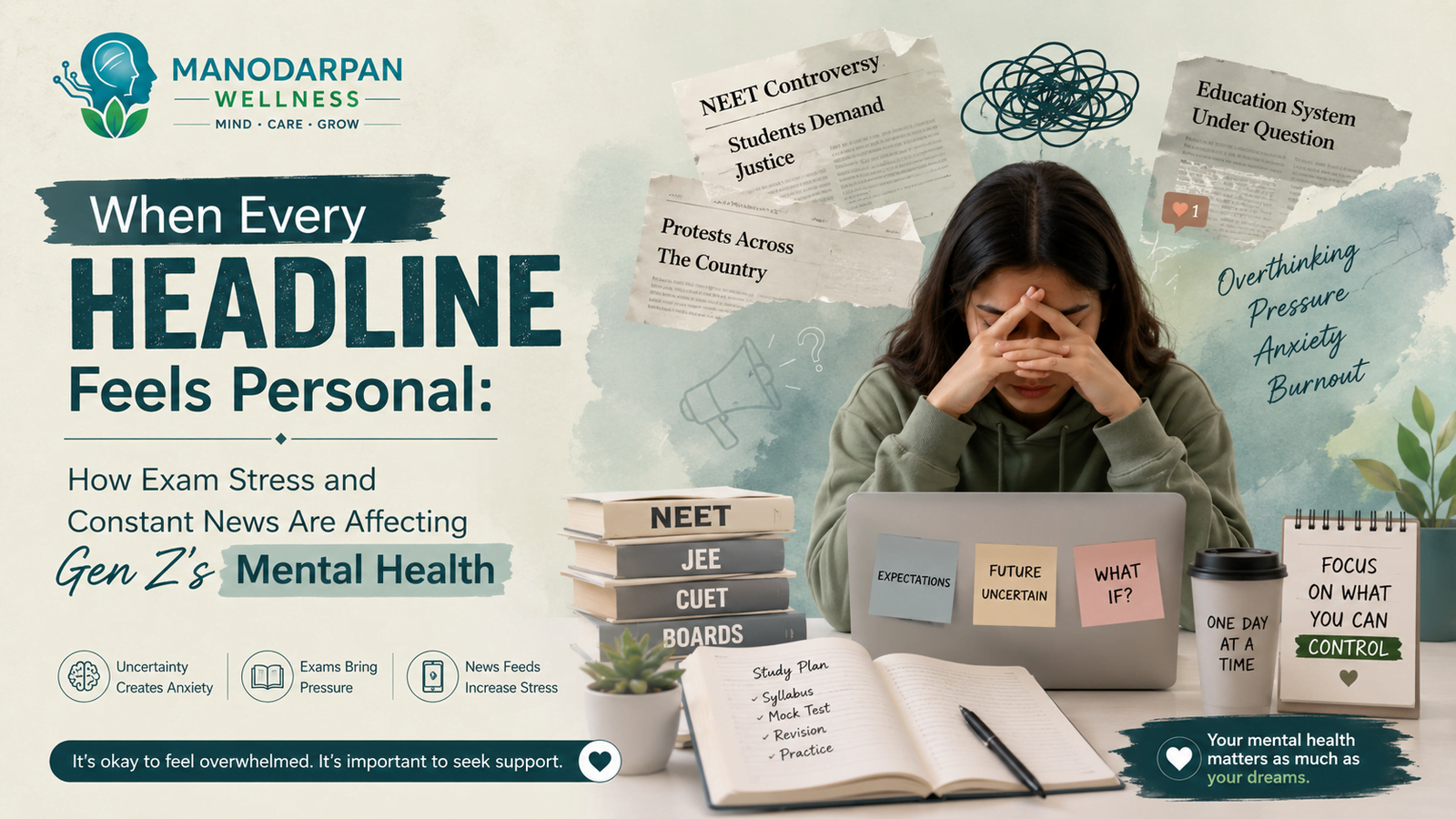
When Every Headline Feels Personal: How Exam Stress and Constant News Are Affecting Gen Z's Mental Health
- 17 Jul 2026
- exam stress, Gen Z mental health, student mental h...
One day, your social media feed is filled with conversations about the NEET examination.
The next day, it's filled with debates about education policies, student protests, and the future of young people.
Every notification, every reel, every news headline seems to ask the same question:
"What if my future isn't secure?"
For many Gen Z students, this isn't just news anymore—it's something they feel deeply. Academic competition, uncertainty, public discussions around education, and the constant pressure to succeed are becoming a daily source of stress.
The emotional weight of these experiences is real, and it's important that we start talking about it.
Why Gen Z Feels More Overwhelmed Than Ever:
Today's generation has access to more information than any generation before it.
While this keeps young people informed, it also means they are constantly exposed to uncertainty, comparison, and pressure.
Students aren't only preparing for exams anymore.
They're also consuming endless opinions, debates, rankings, success stories, and breaking news—often all before breakfast.
The mind rarely gets a chance to rest.
When Education Becomes More Than Just Studying:
For many students, exams like NEET, JEE, UPSC, CUET, or university entrance tests aren't simply examinations.
They often become linked to:
- Self-worth
- Family expectations
- Financial security
- Career dreams
- Social acceptance
When so much depends on a single result, it's natural for anxiety to increase.
The Emotional Impact of Constant Education-Related News:
Whenever educational controversies, protests, or policy discussions dominate headlines, many students begin questioning their own future.
Thoughts like these become common:
"What if all my hard work goes to waste?"
"Will the system ever be fair?"
"Am I preparing for something uncertain?"
Even students who aren't directly affected may experience emotional stress because uncertainty itself creates anxiety.
How Social Media Makes It Even Harder:
Social media has turned every educational issue into a 24-hour conversation.
Students constantly see:
- Rank comparisons
- Study routines
- Success stories
- Fear-based content
- Opinions from thousands of strangers
- Viral debates
Instead of feeling motivated, many begin feeling overwhelmed.
The brain never gets a break from thinking about the future.
Signs That Academic Pressure Is Affecting Your Mental Health:
Constant overthinking:
Your mind keeps replaying worst-case scenarios.
Difficulty sleeping:
Even after studying all day, your brain refuses to switch off.
Loss of motivation:
Tasks that once felt manageable now feel exhausting.
Feeling guilty while taking breaks:
Rest begins to feel like wasting time.
Comparing yourself with everyone else:
You begin measuring your worth through marks, ranks, and achievements.
Emotional exhaustion:
You feel tired—not because of studying alone—but because your mind is carrying too much.
You Are More Than Your Marks:
One exam can influence your career.
It should never define your identity.
Your kindness.
Your creativity.
Your resilience.
Your ability to grow.
None of these can be measured by a scorecard.
Success has many paths, even if they don't all look the same.
How Students Can Protect Their Mental Health:
Create " No - News " Time:
You don't need to follow every update every hour.
Choose one reliable source and limit how often you check it.
Take Social Media Breaks:
Scrolling for hours won't improve preparation.
Resting your mind often improves focus.
Focus on what you can control:
You cannot control policy changes or public debates.
You can control your preparation, your routine, and how you care for yourself.
Talk about your feelings:
Pressure feels heavier when carried alone.
Speak with your parents, teachers, friends, or a mental health professional if you're feeling overwhelmed.
Remember that rest is Productive:
Your brain needs recovery to perform at its best.
Breaks are part of preparation—not a distraction from it.
When Should You Seek Professional Help?
If exam stress, anxiety, uncertainty, or constant worry begins affecting your sleep, concentration, appetite, relationships, or daily life, it may be time to seek professional support.
Early intervention doesn't just improve mental health—it can also improve focus, confidence, and emotional resilience during challenging times.
How Manodarpan Wellness Can Help:
At Manodarpan Wellness, we understand that academic pressure is about more than marks. It's about hopes, expectations, uncertainty, and emotional wellbeing.
Our experienced mental health professionals provide confidential online consultations to help students manage exam anxiety, stress, burnout, overthinking, and emotional challenges. Every conversation is a safe space where you can be heard without judgment.
Conclusion:
The conversations around exams, education, and the future are important. But while society debates systems and policies, we must not forget the emotional wellbeing of the students living through them.
Your future matters—but so does your mental health.
No exam, no headline, and no public debate should make you believe that your worth depends on a single outcome.
Take care of your mind with the same dedication that you bring to your studies. Because success is not only about reaching your destination—it's also about protecting yourself along the way.