Can AI Replace a Therapist? The Truth About Using Chatbots for Mental Health Support
- 19 Oct 2026
- AI and mental health, can AI replace a therapist,...
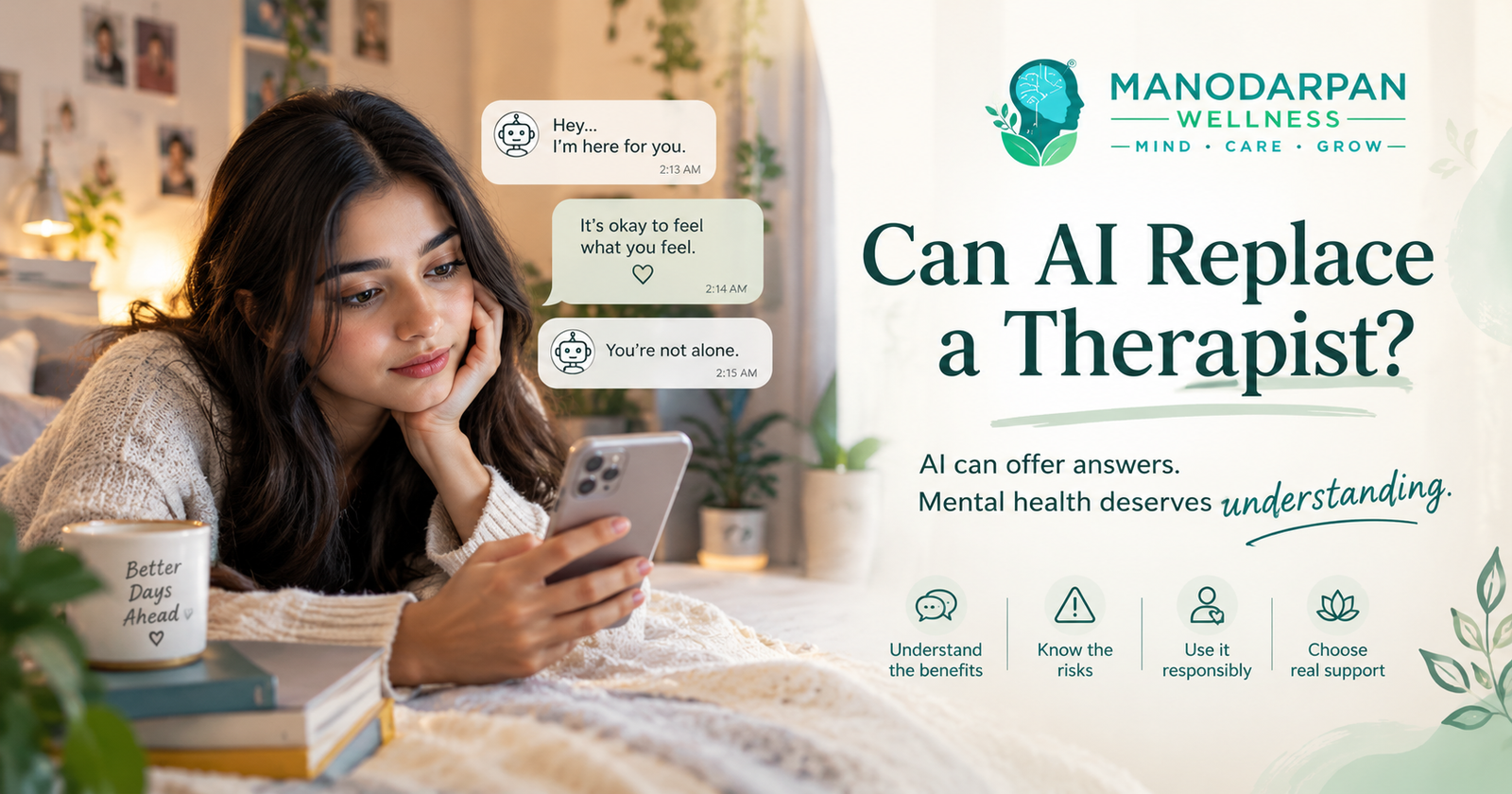
AI and mental health are becoming closely connected. But can a chatbot really understand your emotions, help you navigate difficult experiences, or replace professional psychological support?
Imagine having a difficult day. You feel anxious, overwhelmed, or emotionally exhausted, but you don't know whom to talk to. Instead of calling a friend or booking a therapy session, you open an AI chatbot.
You type everything you have been holding inside. Within seconds, it responds with reassuring words, practical suggestions, and questions that encourage you to reflect on your feelings.
For a moment, you feel heard.
For many people, this is becoming a familiar experience. Artificial intelligence tools are increasingly being explored for emotional support, self-reflection, and mental-health information. They are accessible, convenient, and available whenever someone wants to talk.
But an important question remains: Can AI truly replace a therapist, or is it better understood as a tool that supports mental well-being in certain situations?
Let's explore the benefits, limitations, risks, and responsible ways to use AI when it comes to mental health.
Why Are People Turning to AI for Emotional Support?
Talking about mental health is not always easy. Some people worry about being judged, misunderstood, or perceived as weak. Others may struggle to find a qualified mental-health professional, afford regular sessions, or make time for appointments.
AI chatbots can feel like a convenient first step because they allow people to express their thoughts without arranging a meeting or waiting for a response.
People may use AI to:
Put confusing emotions into words.
Learn about stress, anxiety, and emotional well-being.
Explore general coping strategies.
Organise thoughts before speaking with a professional.
Practise communicating difficult feelings.
Find information about mental-health support.
For someone who feels hesitant about opening up, a chatbot may provide an initial space for reflection.
However, convenience should not be confused with clinical expertise. A response that sounds empathetic is not necessarily an accurate assessment of someone's psychological needs.
The World Health Organization recognises that digital environments can create opportunities for information and connection while also introducing risks. Their effects depend on how technology is designed, used, and experienced.
Can AI Understand Your Emotions?
AI systems can recognise patterns in language and generate responses that sound supportive. They may help someone identify possible emotions, consider different perspectives, or organise a difficult situation into manageable parts.
But there is an important distinction between responding to emotions and understanding a person's lived experience.
A chatbot does not know your complete life story simply because you have described one difficult situation. It may not recognise important context, family dynamics, cultural factors, non-verbal communication, or changes in your behaviour over time.
It can also misunderstand what you mean, provide inaccurate information, or sound confident even when its response is incomplete.
Human emotions are complex. Two people experiencing similar situations may need very different kinds of support.
This is why a thoughtful response from AI should not automatically be treated as a professional psychological opinion.
AI vs. a Therapist: What's the Difference?
Personalised psychological understanding
A qualified mental-health professional can explore your experiences, history, current difficulties, relationships, and individual needs through an ongoing therapeutic process.
An AI chatbot generally responds to the information you provide within the interaction and may not have a complete or reliable understanding of your circumstances.
Professional assessment
A psychologist can conduct an appropriate psychological assessment, consider alternative explanations for difficulties, and determine whether further evaluation or treatment may be needed.
An ordinary AI chatbot is not a substitute for a professional assessment or diagnosis.
Accountability and ethical practice
Qualified professionals are expected to work within professional standards, maintain appropriate boundaries, and protect client confidentiality in accordance with applicable rules and laws.
AI services have different privacy policies, safety measures, and limitations. Users should understand how their information may be stored or processed before sharing sensitive personal details.
A continuing therapeutic relationship
Therapy involves more than receiving advice. It can include building trust, understanding recurring patterns, developing coping skills, and working through difficult experiences over time.
AI may help with reflection, but it cannot be assumed to provide the same relationship, clinical judgement, or continuity of care.
The Risks of Relying on AI for Mental Health
AI can be useful in certain contexts, but relying on it as your only source of mental-health support can create problems.
Incorrect or misleading information
AI may generate advice that sounds convincing but is inaccurate or unsuitable for your situation. Following such advice without professional guidance may delay appropriate support.
Missing the bigger picture
A person may describe feeling tired, distracted, or anxious without mentioning other important factors. A chatbot may not ask the right follow-up questions or identify when a concern needs more careful assessment.
Privacy concerns
Mental-health conversations can contain highly personal information. Before using an AI platform, review its privacy settings and policies. Avoid sharing identifying details, private records, passwords, or other sensitive information unnecessarily.
Delaying professional help
If you are experiencing persistent emotional distress, relationship difficulties, significant sleep problems, or challenges that interfere with daily life, repeated conversations with a chatbot may not address the underlying concern.
AI should not become a reason to postpone an assessment or treatment that you need.
False reassurance during a crisis
A chatbot may not reliably recognise the seriousness of every emergency or provide the appropriate response. If you or someone else is in immediate danger, contact local emergency services or a trusted person who can help you access urgent support.
How to Use AI Responsibly for Mental Well-Being
You do not necessarily have to avoid AI completely to protect your mental health. The goal is to understand its limitations and use it thoughtfully.
Here are a few practical guidelines.
Use it for reflection, not diagnosis. You might ask for help identifying common stress-management techniques, but do not rely on a chatbot to determine whether you have a mental-health condition.
Treat suggestions as information to evaluate. AI-generated advice is not automatically correct. Consider whether it fits your circumstances, and consult a qualified professional when the concern is significant.
Protect your privacy. Keep personal details to a minimum and understand the platform's data practices before sharing sensitive information.
Maintain human connections. Conversations with trusted friends, family members, or other supportive people can be important. Technology should not become your only source of connection.
Seek professional support when needed. If emotional difficulties are persistent, overwhelming, or affecting your everyday life, consider speaking with a qualified mental-health professional.
Remember that AI is a tool, not a measure of your worth. You do not need to solve every emotional difficulty on your own, whether through technology or otherwise.
When Should You Consider Speaking to a Psychologist?
It may be helpful to seek professional support when you notice that:
Anxiety or sadness is becoming persistent or difficult to manage.
You feel emotionally exhausted most of the time.
Sleep, concentration, relationships, or daily responsibilities are being affected.
You repeatedly experience the same distressing thoughts or relationship patterns.
You are struggling to cope with grief, major life changes, or personal challenges.
You want a safe, structured space to understand yourself and develop healthier coping strategies.
You do not need to wait until things become unbearable before reaching out. Psychological support can also help you understand yourself better, strengthen coping skills, and navigate everyday challenges.
The Future of Mental Health: Technology With a Human Touch
Technology may play a meaningful role in making mental-health information easier to access. AI tools can help people explore general information, organise their thoughts, and discover questions they may want to discuss with a professional.
However, accessibility alone does not guarantee that a tool is accurate, safe, or suitable for every person.
A responsible approach combines the convenience of technology with awareness of its limitations, meaningful human connection, and access to qualified care when needed.
The important question is not simply whether AI can talk about emotions. It is whether the support being offered is appropriate, safe, and genuinely helpful for the person's circumstances.
Mental health deserves more than quick answers. It deserves understanding, care, and support that respects each person's individual experience.
Frequently Asked Questions:
1. Can AI replace a psychologist?
No. General-purpose AI chatbots should not be considered replacements for qualified psychologists. They may offer general information or help with reflection, but they cannot be assumed to provide a comprehensive psychological assessment or appropriate treatment.
2. Is it okay to talk to AI when I feel lonely?
AI may provide a convenient way to organise thoughts or explore general coping ideas. However, it is important to maintain human connections and seek additional support if loneliness or emotional distress persists.
3. Can AI diagnose anxiety or depression?
A general-purpose chatbot cannot reliably establish a clinical diagnosis. If you are concerned about symptoms of anxiety, depression, or another mental-health condition, consult a qualified professional.
4. Is AI mental-health advice always safe?
No. AI can provide inaccurate, incomplete, or unsuitable suggestions. Check important information, protect your privacy, and seek professional guidance for significant concerns.
5. When should I seek professional mental-health support?
Consider seeking support if your emotions or experiences are persistently distressing, affect your everyday life, or feel difficult to manage alone. You do not need to wait for a crisis to ask for help.
Your Mental Health Matters:
In a world where answers are available within seconds, remember that understanding yourself can take time. Not every feeling needs an immediate solution, and not every difficult experience can be resolved through a conversation with technology.
AI may help you begin reflecting on what you feel. But you deserve support that takes your individual experiences seriously and helps you navigate them safely.
At Manodarpan Wellness, we believe that mental well-being begins with understanding, compassion, and access to appropriate support.
You do not have to handle everything alone. Taking the first step towards seeking support is a meaningful step towards caring for yourself.
Manodarpan Wellness — Mind. Care. Grow.