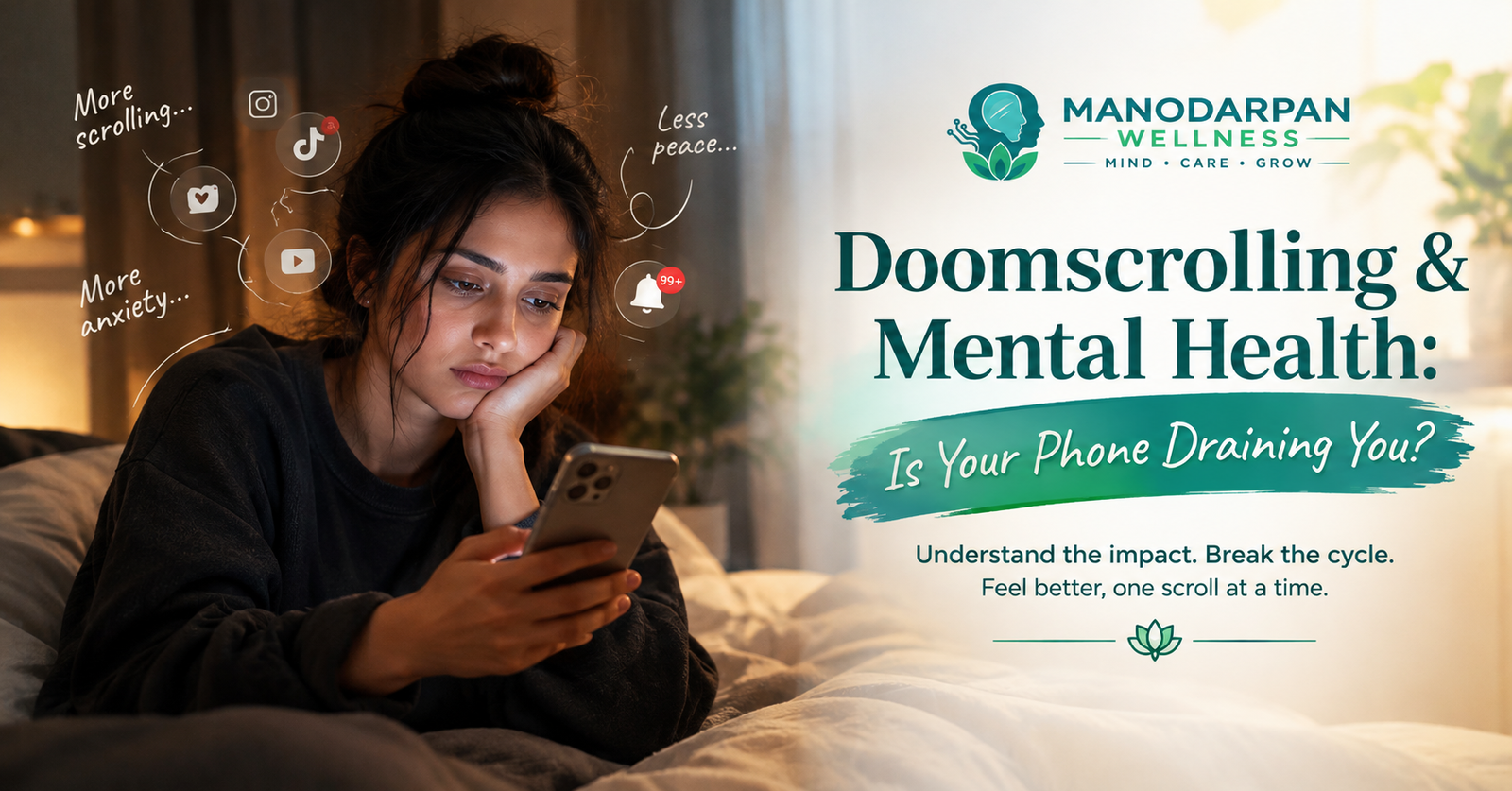
Doomscrolling and Mental Health: Why You Feel Anxious After Scrolling—and How to Break the Cycle
- 13 Oct 2026
- doomscrolling and mental health, what is doomscrol...
You picked up your phone for five minutes. Somehow, 45 minutes have passed. You have seen disturbing news, someone else's achievements, a perfect-looking life, and countless posts that make you question your own. You put your phone down, but your mind doesn't feel any lighter.
Have you ever experienced this?
You are not necessarily looking for bad news. You might simply want to relax, distract yourself, or find out what is happening in the world. Yet, one post leads to another, one video becomes twenty, and before you realise it, your mind feels more crowded than before.
This habit is commonly known as doomscrolling.
In a world where information is available every second, doomscrolling has become an important conversation in mental health. But why do we keep scrolling when it leaves us feeling overwhelmed? Can it affect our emotional well-being? And how can we take back control without completely disconnecting from the digital world?
Let's understand the psychology behind this habit and explore practical ways to create a healthier relationship with our phones.
What Is Doomscrolling?
Doomscrolling is the habit of continuously consuming negative, disturbing, stressful, or upsetting content online, even when you know it is affecting your mood.
It might begin with checking the news. Then you read about another crisis, watch a video about a worrying event, open the comments, and continue scrolling to understand what is happening.
Sometimes, doomscrolling also involves comparing your life with other people's lives. You see someone's career success, relationship, holiday, appearance, or lifestyle and begin wondering why your own life feels different.
Although these experiences are not identical, both can leave you mentally exhausted.
The important thing to understand is that spending time online is not automatically harmful. The concern begins when your scrolling becomes difficult to control or repeatedly leaves you feeling worse.
Digital spaces can help us learn, connect with people, find support, and access mental health information. However, they can also expose us to distressing content and unhealthy comparison. The World Health Organization recognises that digital environments can create both opportunities and risks for mental health, particularly for young people.
Why Do We Keep Scrolling Even When It Makes Us Feel Worse?
Have you ever told yourself, “Bas, one last reel,” and then continued for another half an hour?
There are several possible reasons behind this behaviour.
1. Your brain wants to know what happens next
When something worrying happens, we naturally want information. We may believe that reading one more update will help us understand the situation or feel more prepared.
But online information rarely has a clear ending.
There is always another update, another opinion, another video, or another possibility to consider. Instead of feeling informed and satisfied, you may end up feeling more uncertain.
2. Uncertainty can make it difficult to switch off
Sometimes, we continue checking our phones because we want reassurance.
We might repeatedly check messages, news updates, or social media because we feel uncomfortable not knowing what is happening.
The difficulty is that constant checking does not always provide lasting reassurance. For some people, it can become a repetitive cycle: feeling worried, checking for information, feeling briefly relieved, and then becoming worried again.
3. Scrolling can become an escape from uncomfortable feelings
Not every scrolling habit begins with curiosity. Sometimes, it begins with boredom, loneliness, stress, or a difficult day.
Opening Instagram or another app can provide a temporary distraction from thoughts we do not want to face.
But if scrolling becomes our main way of dealing with uncomfortable emotions, those feelings may remain unaddressed after the screen goes off.
4. Social comparison can make ordinary life feel inadequate
Social media often shows selected moments rather than someone's entire life.
You may see another person's promotion without knowing about their struggles, a happy couple without knowing their challenges, or someone's achievements without seeing the years of effort behind them.
When you compare your everyday life with someone else's carefully selected moments, it can become easy to feel behind.
Remember, you are comparing your full reality with a small part of someone else's life.
How Can Doomscrolling Affect Your Mental Health?
Doomscrolling does not affect everyone in the same way, and it does not automatically cause a mental health condition. However, research has found associations between excessive doomscrolling and poorer psychological well-being. These findings do not prove that scrolling alone causes these outcomes, and individual experiences can vary.
Here are some ways this habit may affect your daily life.
1. Increased worry and anxiety
Repeated exposure to distressing information can leave some people feeling tense, worried, or constantly alert.
Even after closing an app, you might continue thinking about what you have seen. You may begin imagining worst-case scenarios or worrying about things outside your immediate control.
2. Mental exhaustion
Your mind needs time to process information, focus on tasks, and rest.
Moving rapidly between news updates, videos, messages, and opinions can leave you feeling mentally overloaded, particularly when you are already stressed or tired.
You might notice difficulty concentrating, reduced motivation, or a feeling that your mind has too much going on at once.
3. Disrupted sleep routines
Late-night scrolling can push your bedtime further away. Emotionally upsetting content may also make it harder to settle your thoughts before sleeping.
If you regularly stay awake checking your phone, you may wake up tired and find it more difficult to manage stress the next day.
4. Lower mood and unhealthy comparison
Repeatedly viewing distressing news or comparing yourself with others can influence how you feel about your life.
You might start questioning your progress, appearance, relationships, or achievements.
If these feelings become persistent or interfere with daily functioning, it may be helpful to speak with a qualified mental health professional.
5. Less time for real-life connection
Scrolling can gradually replace activities that help you feel connected and refreshed, such as talking to a friend, going for a walk, spending time with family, or enjoying a hobby.
The goal is not to avoid technology completely. It is to make sure your online life does not consistently push aside the things that support your well-being.
Signs Your Scrolling Habit May Be Affecting You
Ask yourself the following questions:
Do you open social media automatically whenever you feel bored or uncomfortable?
Do you keep checking upsetting news even when you know it affects your mood?
Do you often spend much longer scrolling than you intended?
Do you compare your appearance, achievements, or relationships with people online?
Do you feel restless when your phone is not nearby?
Does late-night scrolling affect your sleep?
Do you feel mentally drained, anxious, or dissatisfied after using certain apps?
Have you started avoiding activities or conversations because you spend so much time online?
Occasionally answering yes does not mean you have an addiction or a mental health disorder. These questions are simply an opportunity to notice patterns and decide whether a few changes could help.
How to Stop Doomscrolling Without Giving Up Social Media
You do not have to delete every app, stop reading the news, or become unavailable to your friends.
A more realistic approach is to make small changes that help you use technology intentionally.
1. Notice how you feel before and after scrolling
The next time you pick up your phone, pause for a moment.
Ask yourself: “Am I opening this app because I want to, or because I am trying to avoid something?”
After scrolling, notice your mood. Do you feel informed, entertained, connected, anxious, or drained?
This simple habit can help you identify which activities are useful and which ones may be affecting you negatively.
2. Create phone-free moments
You do not need to begin with an entire day without your phone.
Start with manageable boundaries, such as:
Keeping your phone away during meals.
Avoiding social media during the first few minutes after waking up.
Setting aside time before bed without scrolling.
Taking short breaks between study or work sessions.
Choose boundaries that fit your routine rather than following rules that feel impossible to maintain.
3. Turn off unnecessary notifications
Every notification creates another opportunity to interrupt what you are doing.
Consider disabling alerts from apps that do not require your immediate attention. You can also mute accounts or topics that repeatedly leave you feeling overwhelmed.
This does not mean ignoring the world. It means deciding when and how you want to engage with it.
4. Set a specific time for checking the news
Staying informed is important, but checking updates throughout the day may not be necessary.
Try choosing a reliable news source and checking it at a time that suits you. If a story is particularly distressing, give yourself permission to step away after receiving the information you need.
You can care about what is happening in the world without exposing yourself to every update, comment, or video.
5. Replace scrolling with something that genuinely helps you relax
Simply telling yourself to stop scrolling may not work if your phone has become your main source of comfort or distraction.
Instead, prepare a few alternatives:
Take a short walk.
Listen to music.
Write down what is on your mind.
Call someone you trust.
Spend a few minutes stretching or breathing slowly.
Read a book or enjoy a hobby.
Sit quietly without needing to fill every moment.
The aim is not to make every minute productive. It is to give your mind opportunities to rest without constantly consuming new information.
6. Curate your social media feed
Pay attention to how different accounts make you feel.
Some may help you learn, laugh, connect, or feel understood. Others may repeatedly trigger comparison, fear, or self-doubt.
Unfollowing, muting, or limiting certain accounts can be a reasonable form of self-care.
You do not need to keep consuming content that consistently makes you feel worse just because everyone else is watching it.
7. Learn to tolerate being offline
Sometimes, the urge to check your phone appears simply because there is a quiet moment.
You might feel uncomfortable waiting, sitting alone, or not knowing what everyone else is doing.
Try allowing a few of these moments to exist without immediately reaching for your phone.
You do not have to respond to every notification or know every update as soon as it happens. It is okay to be unavailable for a while.
What If You Scroll Because You Feel Lonely, Stressed, or Overwhelmed?
This is an important question because the habit may not be the whole problem.
Imagine someone returning home after a difficult day. They feel lonely, but they do not know whom to call. They open social media to distract themselves.
For a little while, the videos help. Then they see people meeting friends, travelling, celebrating achievements, and enjoying their lives. Instead of feeling better, they begin to feel even more disconnected.
They continue scrolling because stopping would mean returning to the feelings they were trying to avoid.
This is one possible experience, not everyone's story. But it illustrates why understanding the reason behind a habit can be more useful than simply blaming yourself for it.
If you notice that you regularly turn to your phone when you feel lonely, anxious, or emotionally overwhelmed, consider what support you might need beyond screen-time limits.
You might need more meaningful connection, better ways to manage stress, time to process a difficult experience, or professional support.
Sometimes, the question is not just “How do I stop scrolling?” It is also “What am I looking for when I scroll?”
Understanding that difference can help you make changes that address the underlying need rather than only the behaviour.
When Should You Seek Mental Health Support?
It may be helpful to speak with a psychologist or another qualified mental health professional if:
Anxiety, sadness, or worry is becoming persistent.
Your sleep or concentration is regularly affected.
You feel unable to control a habit despite repeated attempts.
Social comparison is affecting your self-esteem.
You are withdrawing from people or activities you previously enjoyed.
Stress is interfering with your studies, work, relationships, or daily life.
You do not need to wait until things feel unbearable before asking for help.
A mental health professional can help you understand your patterns, explore the emotions behind them, and develop coping strategies that suit your individual needs.
Seeking support is not a sign of weakness, and taking a break from social media is not a substitute for professional care when you need it.
Frequently Asked Questions About Doomscrolling and Mental Health
What is doomscrolling in simple words?
Doomscrolling means repeatedly scrolling through negative, disturbing, or worrying online content, even when you know it is affecting your mood or well-being.
Can doomscrolling cause anxiety?
Doomscrolling has been associated with anxiety and psychological distress, but research does not establish that it directly causes anxiety in every person. Your existing stress levels, personal circumstances, sleep, and online experiences can all influence how you feel.
Why do I keep scrolling even when I want to stop?
You may be looking for information, reassurance, distraction, entertainment, or connection. Endless feeds and frequent updates can also make it easy to continue longer than intended. Noticing what triggers the urge can help you change the pattern.
How do I stop doomscrolling at night?
Try setting a time to stop using social media before bed, keeping your phone away from your pillow, muting unnecessary notifications, and choosing a calming alternative such as reading or listening to gentle music. If sleep difficulties persist, consider speaking with a healthcare professional.
Is social media always bad for mental health?
No. Social media can help people connect, learn, express themselves, and find supportive communities. Its impact depends on factors such as the content you see, how you use platforms, your personal circumstances, and whether online activities interfere with sleep, relationships, or everyday life.
Should I see a psychologist for social media-related stress?
Consider professional support if social media use is linked to persistent anxiety, low mood, sleep problems, self-esteem concerns, or difficulties in daily life. A psychologist can help you understand your experience and identify practical ways to cope.
You Deserve a Life That Feels Good Offline, Too
We live in a world where there is always something new to watch, read, react to, or worry about.
There will always be another update. Another trend. Another achievement to compare yourself with. Another reason to pick up your phone.
But you are allowed to pause.
You are allowed to protect your attention, step away from distressing content, and enjoy moments that do not need to be photographed or shared. You are allowed to have a quiet evening without knowing what everyone else is doing.
Your life does not have to compete with what you see on a screen.
And if you find that your relationship with technology is affecting your emotional well-being, remember that you do not have to figure everything out alone.
At Manodarpan Wellness, we believe that understanding your mind is an important step towards caring for yourself. Whether you are dealing with stress, anxiety, emotional exhaustion, or difficulties with everyday life, seeking appropriate support can help you move forward.
Your mental health deserves attention—not only when things become difficult, but as part of your everyday life.
Manodarpan Wellness — Mind. Care. Grow.
Take a moment to put your phone down, breathe, and check in with yourself. Sometimes, the most important conversation is the one you have with yourself.