Understanding the Biopsychosocial Model: How Your Body, Mind and Environment Shape Your Mental Health
- 17 Nov 2026
- biopsychosocial model, biopsychosocial approach, b...
Have you ever wondered why two people can experience the same stressful situation but react in completely different ways?
For example, imagine two students preparing for an important examination. Both have the same syllabus, similar deadlines, and the same academic pressure. One student feels motivated and manages the stress reasonably well, while the other experiences anxiety, difficulty sleeping, and constant self-doubt.
Why does this happen?
The answer is not always as simple as personality or willpower. Our mental health is influenced by several interconnected factors, including our physical health, thoughts, emotions, relationships, and surrounding environment.
This is where the Biopsychosocial Model helps us understand the bigger picture.
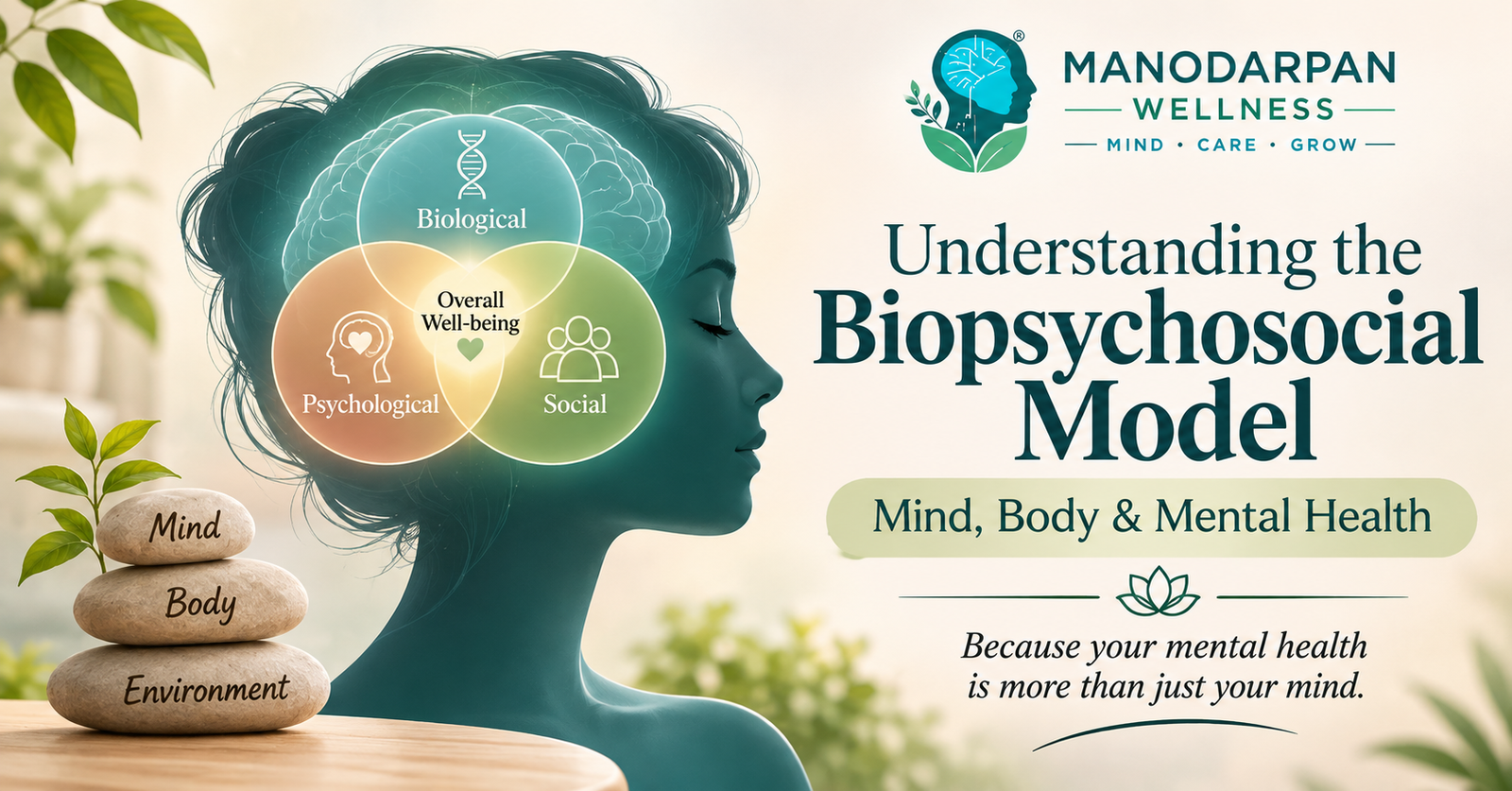
The model explains that human health and well-being are shaped by three interconnected dimensions:
Biological: What happens in your body.
Psychological: What happens in your mind.
Social: What happens in your relationships and environment.
Rather than looking at mental health from just one perspective, this approach encourages us to understand the whole person.
In this article, let's explore the biopsychosocial model, understand its three dimensions, and discover why all three matter when it comes to mental well-being.
What Is the Biopsychosocial Model?
The Biopsychosocial Model is an approach to understanding health and illness through the interaction of biological, psychological, and social factors.
It was formally introduced by psychiatrist Dr. George L. Engel in 1977 as an alternative to an exclusively biomedical understanding of illness.
The traditional biomedical approach focuses primarily on biological processes and physical abnormalities. Engel argued that understanding a person's health also requires considering their psychological experiences and social circumstances.
In simple words, a person's health cannot always be understood by looking at the body alone.
For example, someone experiencing anxiety may also be dealing with sleep difficulties, negative thought patterns, family pressure, financial uncertainty, or relationship challenges.
These factors can influence one another and contribute to the person's overall experience.
The biopsychosocial model encourages a more complete and compassionate understanding of health.
The Three Main Components of the Biopsychosocial Model
1. Biological Factors: Understanding the Role of Your Body
The biological dimension focuses on the physical and physiological factors that may influence mental health.
Our brain and body are closely connected. Physical health, genetics, sleep, and other biological processes can influence our emotions, concentration, energy, and stress responses.
Some important biological factors include:
Genetics and family history
Genetic factors can influence a person's vulnerability to certain mental-health conditions. However, having a family history does not mean someone will necessarily develop the same condition.
Sleep patterns
Sleep plays an important role in emotional regulation, memory, concentration, and everyday functioning.
Poor or disrupted sleep may contribute to irritability, difficulty concentrating, and increased emotional sensitivity.
Hormonal changes
Hormonal changes during different stages of life can influence mood, energy, and emotional experiences.
Physical health conditions
Chronic pain, long-term illnesses, nutritional deficiencies, and other physical health concerns may affect emotional well-being.
Brain and nervous system functioning
The brain and nervous system are involved in processing emotions, responding to stress, and regulating behaviour.
It is important to remember that biological factors are only one part of the picture. They do not independently explain every emotional or psychological experience.
2. Psychological Factors: Understanding Your Thoughts and Emotions
The psychological dimension focuses on how individuals think, feel, interpret situations, and respond to experiences.
Two people can experience the same event but interpret it differently because of their beliefs, previous experiences, coping strategies, and thought patterns.
Some important psychological factors include:
Thought patterns
The way we interpret situations can influence our emotional responses.
For example, if a friend does not reply to a message, one person may think, "They must be busy," while another may think, "Maybe they are upset with me."
The situation is the same, but the interpretation is different.
Emotional regulation
Emotional regulation refers to the ways people recognise, understand, and manage their emotional responses.
Difficulty managing overwhelming emotions may affect relationships, decision-making, and daily activities.
Self-esteem and self-confidence
The way we view ourselves can influence how we respond to criticism, challenges, failure, and relationships.
Past experiences
Previous experiences, including difficult life events, may shape how a person interprets situations and responds to stress.
Coping mechanisms
People develop different ways of dealing with challenges. Some may communicate their feelings, seek support, or solve problems, while others may avoid difficult situations or suppress their emotions.
Understanding these psychological patterns can help individuals recognise their needs and develop healthier coping strategies.
3. Social Factors: Understanding the World Around You
The social dimension focuses on how relationships, family, culture, community, work, and living conditions influence mental health.
We do not experience life in isolation. Our surroundings can provide emotional support, create opportunities, or introduce additional stress.
Some important social factors include:
Family environment
Family relationships, communication patterns, expectations, and emotional support can influence a person's sense of security and well-being.
Friendships and relationships
Healthy relationships can provide belonging, understanding, and support during difficult situations.
On the other hand, conflict, rejection, isolation, or unhealthy relationship patterns may contribute to emotional distress.
Academic and workplace pressure
Students may experience examination stress, competition, and expectations about their future.
Working professionals may face deadlines, job insecurity, workplace conflict, and difficulties maintaining work-life balance.
Financial circumstances
Financial uncertainty, unemployment, and economic pressure can create ongoing stress and affect emotional well-being.
Culture and society
Cultural expectations, social stigma, discrimination, and community attitudes can influence how people understand mental health and whether they feel comfortable seeking help.
The social environment matters because feeling accepted, respected, and supported can make a meaningful difference to overall well-being.
How Do Biological, Psychological and Social Factors Work Together?
The most important feature of the biopsychosocial model is that its three dimensions do not operate independently.
They continuously interact and can influence one another.
Let's understand this through a simple example.
Example: A Student Experiencing Examination Anxiety
Imagine a student who has an important examination approaching.
Biological factors:
The student is sleeping fewer hours.
They feel physically tired.
Their appetite and daily routine have changed.
Psychological factors:
They worry about failing.
They compare their performance with classmates.
They experience self-doubt and difficulty concentrating.
Social factors:
Family members expect excellent results.
Friends are discussing their preparation.
Academic competition creates additional pressure.
Now notice how these factors may influence one another.
Family and academic pressure may increase worry. Increased worry may interfere with sleep. Poor sleep may make concentration more difficult. Difficulty concentrating may increase self-doubt and create further stress.
This example demonstrates why understanding only one factor may not provide a complete picture.
A more holistic approach considers the student's physical health, thoughts, emotional experiences, and social environment together.
Why Is the Biopsychosocial Model Important for Mental Health?
The model is valuable because it encourages us to look beyond symptoms and understand the person experiencing them.
Here are some important reasons why it matters.
1. It Encourages a Holistic Understanding:
Instead of focusing only on one symptom, the model encourages consideration of the different factors that may be contributing to a person's difficulties.
2. It Recognises Individual Differences:
People have different backgrounds, experiences, physical health conditions, relationships, and coping abilities.
Understanding these differences helps avoid assuming that one explanation or approach will work for everyone.
3. It Highlights the Importance of Relationships:
Social support, family dynamics, friendships, and community environments can all be relevant when understanding a person's mental health.
4. It Encourages Appropriate Professional Support:
Depending on a person's needs, support may involve psychological care, medical evaluation, lifestyle changes, social support, or a combination of approaches.
5. It Helps Reduce Stigma:
The model reminds us that mental-health difficulties are not simply a result of weak willpower or negative thinking.
Biological, psychological, and social circumstances can all be relevant. This encourages a more understanding and compassionate attitude towards mental health.
How Can You Support Your Mental Health Through the Biopsychosocial Approach?
You do not need to change everything in your life at once.
Small, realistic steps across different areas can help support your overall well-being.
Take Care of Your Physical Health
Try to maintain a consistent sleep routine.
Include balanced and nutritious meals.
Stay physically active in a way that suits your health.
Make time for relaxation.
Consult a healthcare professional about persistent physical symptoms or health concerns.
Develop Healthy Psychological Habits
Notice and acknowledge your emotions.
Practise self-compassion instead of constant self-criticism.
Identify unhelpful thinking patterns.
Try journalling or mindfulness if these activities feel helpful.
Develop practical ways to manage everyday stress.
Strengthen Your Social Connections
Spend meaningful time with people you trust.
Communicate your feelings and needs.
Set healthy boundaries.
Ask for help when you need it.
Participate in activities that help you feel connected to your community.
Remember, self-care is not a substitute for professional treatment when it is needed. If emotional or psychological difficulties persist, seeking appropriate support is important.
When Should You Seek Professional Mental Health Support?
Sometimes, understanding your emotions and making lifestyle changes may not be enough.
Consider speaking with a qualified mental-health professional if:
You experience persistent anxiety, sadness, or emotional distress.
You find it difficult to manage everyday responsibilities.
Sleep or concentration problems continue.
Your relationships or work are being affected.
You feel overwhelmed by repeated thoughts or emotional experiences.
You are struggling to understand what is affecting your well-being.
A psychologist or other appropriate healthcare professional can help explore your experiences, understand relevant factors, and discuss suitable support options.
You do not need to wait until your difficulties become severe before reaching out.
Frequently Asked Questions (FAQs)
1. What is the Biopsychosocial Model in simple words?
The Biopsychosocial Model explains that health and mental well-being are influenced by three interconnected factors: biological, psychological, and social. It considers the body, mind, and surrounding environment together.
2. Who introduced the Biopsychosocial Model?
Psychiatrist Dr. George L. Engel formally introduced the model in his influential 1977 paper, "The Need for a New Medical Model: A Challenge for Biomedicine."
3. What are the three components of the Biopsychosocial Model?
The three components are:
Biological: Genetics, sleep, hormones, brain functioning, and physical health.
Psychological: Thoughts, emotions, beliefs, self-esteem, and coping strategies.
Social: Family, relationships, culture, finances, work, and environment.
4. How does the Biopsychosocial Model explain mental health?
It explains that mental health cannot always be understood through one factor alone. Biological processes, psychological experiences, and social circumstances may interact and influence a person's overall well-being.
5. Why is the Biopsychosocial Model important in psychology?
It provides a broader framework for understanding individuals and their experiences. It encourages professionals to consider the whole person rather than focusing only on symptoms or a single cause.
6. Can social factors affect mental health?
Yes. Family relationships, social support, financial circumstances, workplace conditions, discrimination, and isolation can all influence emotional well-being.
7. Does the Biopsychosocial Model mean mental-health problems are caused by all three factors?
Not necessarily. The relative contribution of biological, psychological, and social factors can vary between individuals and conditions. Some factors may be more relevant than others in a particular situation.
Final Thoughts: Your Mind, Body and Environment Are Connected
Mental health is not just about thinking positively or trying harder to stay happy.
It is influenced by a combination of experiences, circumstances, physical processes, emotions, and relationships.
The Biopsychosocial Model reminds us that understanding a person requires looking beyond what is immediately visible.
Sometimes, improving your well-being may involve addressing sleep difficulties. Sometimes, it may involve understanding unhelpful thought patterns, strengthening relationships, or seeking professional support.
There is no single explanation or solution that applies to everyone.
At Manodarpan Wellness, we believe that every person's mental-health journey deserves understanding, compassion, and an approach that recognises their individual experiences.
Because caring for your mental health also means caring for the person as a whole.
Manodarpan Wellness — Mind. Care. Grow.
Your well-being matters. And you do not have to navigate your journey alone.